Français
 Nederlands
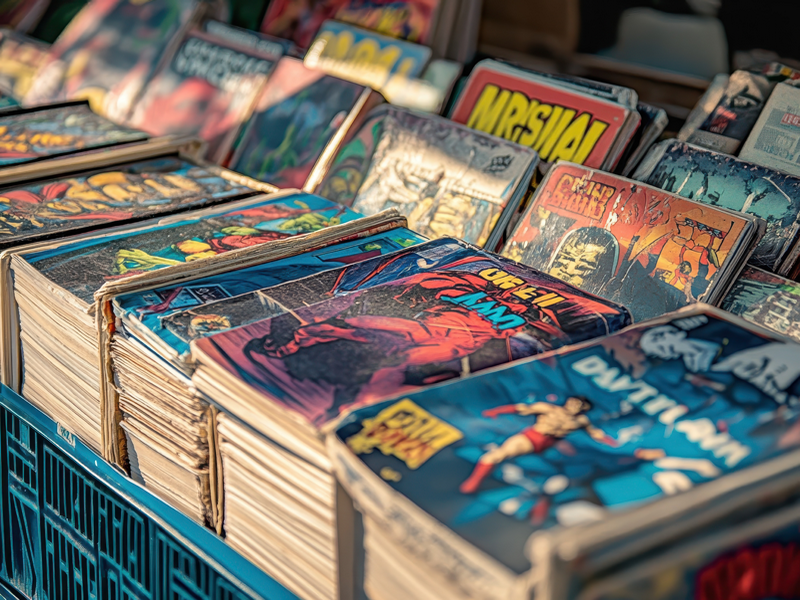
The power of visual narratives
Comics are often wrongly regarded as mere entertainment for youth, but in reality, they form a powerful medium to unlock complex social, historical, and philosophical themes for a broad audience. Through the synthesis of text and image, a unique cognitive experience is created in which the reader is actively involved in interpreting the narrative. This visual literacy allows creators to concretize abstract concepts, lowering thresholds for abstract thought.
When heavy topics such as war trauma or political systems are translated into comic form, visual language helps make the emotional load manageable. The dosage of information, distributed across frames and pages, gives the reader the necessary breathing room to process complex processes at their own pace.
Accessibility through structure
The structure of a comic book, characterized by the sequence of panels, acts as an effective guide through layered stories. This process, which we often call sequential art, provides a natural cadence to the storytelling. Unlike long texts without visual anchors, the illustrations provide a direct contextual anchoring. As a result, even complicated plotlines or scientific concepts can be made understandable for readers who may have less affinity with purely textual media.
Moreover, the interaction between layout and content ensures that cognitive load is optimally managed. Readers can return to previous images to draw connections, which significantly promotes the learning process or understanding of an ethical issue. The medium therefore acts as a bridge between academic complexity and general understanding, where inclusivity is central to how information is conveyed.
Emotional resonance and educational value
In addition to structural advantages, comics offer unparalleled emotional depth that aids in the reader's capacity for empathy. When complex stories are personalized by characters in a drawn environment, readers can more easily identify with situations far from their own reality. This strengthens the educational value of the medium, as abstract facts are transformed into lived experiences that resonate with human nature.
Through the use of color, composition, and expression, comic creators can convey subtle nuances that are often lost in purely written text. These aesthetic choices support the message, making it not only more understandable but also more memorable. The final result is a powerful communication tool that, by leveraging both reason and emotion, stimulates social engagement and democratizes complex narratives for everyone, regardless of their background or education level.